In the familiar version of this game, an object is hidden from one child and his friends watch him/her bumble around the room trying to find it. The friends give the person who is "It" clues such as "You're getting warmer" when the person is getting closer to finding the object, and clues like "You're freezing" when the person who is "It" is very far away.
In this Chinese classroom version, one child is still "It" but instead of his/her friends giving clues such as hot/cold, the friends chant the name of the object hidden (or of the target vocabulary word on a hidden flashcard). As the person who is "It" gets closer to the hidden object/flashcard, the children chant louder and louder. And as the person who is "It" gets farther away, the children chant softer and softer.
What a great game to get the kids to practice saying the target vocabulary! Kids remember better when they are having fun! Also, this is a nice game for helping quiet kids find their voice in the classroom.
I must acknowledge that Nicholas O'Brien, from Kalona Elementary, Iowa showed me this game (here's his blog).

If you want to teach your kids Chinese, but don't speak it yourself, you've come to the right place. The resources I've chosen to compile here are a result of my experiences (as a mom and teacher) and the influences of my background in language development, literacy, and education. I hope that the ideas here will help you find creative ways to teach your children Chinese.
Wednesday, February 29, 2012
Clapping Game

Here's how to play the game- Create a set of flashcards. You can use a picture of the target vocabulary or the Chinese character. Make sure the cards are large enough that the whole class can see the picture/character. Show the class one of the flashcards and say the name of the picture/character. Have the kids repeat it back to you several times. Then ask them to chant the name as you mix the target card back into the deck. Next, hold up one card after another. Tell them to clap/applaud when they see the target card.
What Does the Wind Blow?- Game
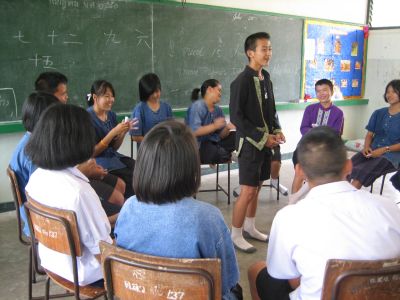
My understanding (and please, correct me if I'm wrong) is that 吹什麼吹? (Chuī shénme chuī?, What does the wind blow?) is a traditional Chinese children's game. It is similar to musical chairs in that there is a ring of chairs and one child sits in each chair. There is another child that stands in the middle with no chair. The child in the middle says, "大風吹," (Dà fēng chuī, A big wind blows) and the children sitting in the chairs respond, "吹什麼吹?" (Chuī shénme chuī?, What does the wind blow?).The child in the middle then calls out something that some of the children have in common like a color. For instance, if the child in the middle called out "藍色," (Lán sè, blue) then every child wearing blue would stand up and try to get to a different chair. The child in the middle will also find an empty chair so that (hopefully) a new child is left in the middle standing and the game begins again.
This game helps to develop listening skills and practices target vocabulary. Colors and clothing are natural vocabulary to use with this game, but you could also get creative and call out things like, "有第第得人." (Yǒu dì'dì dé rén, (People that) have a younger brother.) You could also pass out papers with the target vocabulary (for example, 在, 是, 很 (zài, shì, hěn, to be at, to be, very). Just be sure each vocabulary word is passed out at least twice.
Monday, February 27, 2012
Color Coding Worksheet

Below is a sample Color-Coded Tree and a blank one for you to create your own worksheet using characters you are practicing in your home.
Color Coding Tree- 注音符號
Color Coding Tree- 漢語拼音 (Hànyǔ Pīnyīn)
Color Coding Tree- Blank
Wednesday, February 22, 2012
Dragon Lollipop With Caramel Art !

Dragon Lollipop With Caramel Art- A Chinese street vendor uses melted caramel to make an edible work of art. This is just so different from what an child in America experiences on a day to day basis, that I felt this warranted culture-exposure status. I hope your kids enjoy this!
Want to get an idea about how to create your own sugar art? Watch this Sugar Art Instructional Video.
And here is another video I happened across that demonstrates the Art of Sugar Blowing. Very cool!
Want to get an idea about how to create your own sugar art? Watch this Sugar Art Instructional Video.
And here is another video I happened across that demonstrates the Art of Sugar Blowing. Very cool!
Tuesday, February 21, 2012
Character Artwork With Tissue Paper

To decorate a character start by creating an outline of the character. I created mine using Microsoft Word. After typing the character, I enlarged the character and then (by going to the font tab) I selected "outline". This created a hallow character my kids could fill in with tissue paper, buttons, beans, or fill in with crayons and markers.
If you are less tech-savvy, you can simple draw out an outline of the character.
For this art project, we glued tissue paper onto the outline. I recommend that you do this with kids ages 5 and up. I tried it with my four year old and she tried and had fun, but it didn't come out so well. My five-year old was more successful.
Remember the point of this project isn't to make a beautiful picture (although that is nice, too). It's to help the kids focus on the parts of the character. As you will notice above, we used different colors for the different parts of the character, which really allows us to see the different components (such as 艹 and 人).
Friday, February 17, 2012
Animated Stroke Orders for Common Characters

Subscribe to:
Posts (Atom)