Showing posts with label Culture. Show all posts

Thursday, August 23, 2012

Tangrams


Looking for some cultural activities that your young child can participate in?  Check out Activity Village's tangram page.  There is a pattern you can print to make your own tangram set and several fun tangram patterns you can puzzle out!

Want to know how to say "tangram" in Chinese?
- 七巧
- 七巧板 (qī qiǎo bǎn)

Sunday, August 5, 2012

Culture Kits

If you live near a university with an international program or a well-funded library, ask if they have Culture Kits available.  These are simply tubs of materials that are about a particular culture.  A Chinese Culture Kit might include realia such as:  traditional rice steamers, chopsticks, paper lanterns, traditional toys, and jewelry.  Each Culture Kit typically also provides an Information Sheet listing facts about the items in the kit.

If you live near Iowa City, the international program at the University of Iowa has several Culture Kits that can be checked out for two-weeks.  There is a 5 kit maximum.  Below are some links that direct you to the Culture Kits available at UI.
Home page for Culture Kits
List of kits searched by keywords:  China, Chinese, Taiwan, Asia

Saturday, August 4, 2012

Wednesday, February 29, 2012

What Does the Wind Blow?- Game


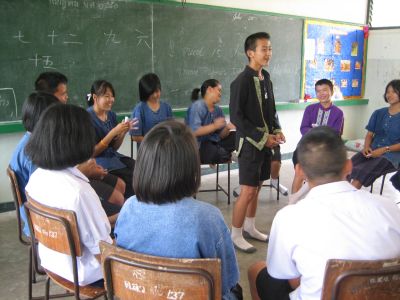
My understanding (and please, correct me if I'm wrong) is that 吹什麼吹? (Chuī shénme chuī?, What does the wind blow?) is a traditional Chinese children's game.  It is similar to musical chairs in that there is a ring of chairs and one child sits in each chair.  There is another child that stands in the middle with no chair.  The child in the middle says, "大風," (Dà fēng chuī, A big wind blows) and the children sitting in the chairs respond, "吹什麼吹?" (Chuī shénme chuī?, What does the wind blow?).  The child in the middle then calls out something that some of the children have in common like a color.  For instance, if the child in the middle called out "," (Lán sè, blue) then every child wearing blue would stand up and try to get to a different chair.  The child in the middle will also find an empty chair so that (hopefully) a new child is left in the middle standing and the game begins again.

This game helps to develop listening skills and practices target vocabulary.  Colors and clothing are natural vocabulary to use with this game, but you could also get creative and call out things like, "有第第得人." (Yǒu dì'dì dé rén, (People that) have a younger brother.)  You could also pass out papers with the target vocabulary (for example, , , (zài, shì, hěn, to be at, to be, very).  Just be sure each vocabulary word is passed out at least twice.

Wednesday, February 22, 2012

Dragon Lollipop With Caramel Art !

Dragon Lollipop With Caramel Art-  A Chinese street vendor uses melted caramel to make an edible work of art.  This is just so different from what an child in America experiences on a day to day basis, that I felt this warranted culture-exposure status.  I hope your kids enjoy this! 

Want to get an idea about how to create your own sugar art?  Watch this Sugar Art Instructional Video.

And here is another video I happened across that demonstrates the Art of Sugar Blowing. Very cool!

Wednesday, February 15, 2012

Ni Hao Kai-lan

Ni Hao Kai-lan is a good resource for young children who are just being introduced the Chinese.  Not only is some Chinese introduced, there is also an attempt to familiarize viewers with the Chinese culture and traditions.  Check out the website for a complete list of the activities they have available.

Wednesday, February 1, 2012

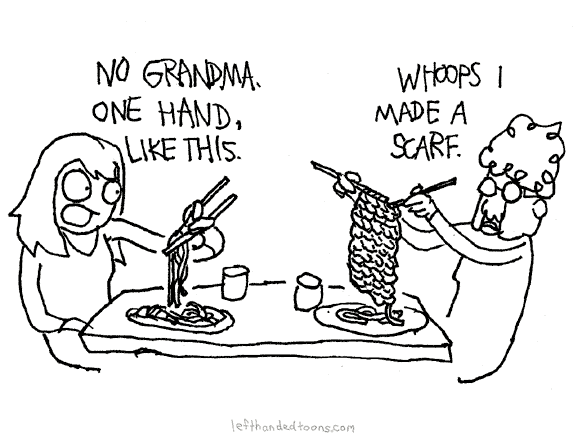
Chopsticks, by Drew

Left-handed Toons (by right-handed people)

Just ran across this and thought of my mom, who's not Asian and who does knit.  Sometimes we have similar conversations, not necessarily about chopsticks.  East meets West!

Rethinking the Oreo . . .

Rethinking the Oreo . . .- For many living in America with an Asian or part-Asian heritage, it is sometimes difficult to find value in our "other" culture.  There is pressure from peers and culture to conform to the American way of doing things.  Sometimes it can feel like the whole world is going American and there is little or no value in the Asian way of doing things.

This article presents the reader with a subtle way Asia is influencing the Western world and is an easy example to use when talking to young kids.

Sunday, January 15, 2012

The Magic Brush

The Magic Brush- This story is a wonderful way to introduce a child to both Chinese characters and its culture.  "Jasmine loves spending time with her agong -grandfather- while her little brother, Tai-Tai, is napping.  Agong teaches her calligraphy, and through the Chinese charactes they draw together, they create a magical world full of flying fish, monkeys, and mythical dragons.  And when the time is right, Jasmine will pass on the traditions to Tai-Tai too . . ."

Inside the book, characters take on life and children can see the pictures behind the pictographic characters:  月, 星, 山, 林, 川, 舟, 水, 魚, 炎, 朋, 馬, 龍, and 公.  At the back of the book is a pronunciation key of each of these characters as well as their meanings.

I should also point out that is available at the North liberty Public Library; The title is The Magic Brush and the call number is under PRIMARY, Author Yeh.
Rhythms and Tones

Rhythms and Tones- This is a wonderful book to expose kids who are learning Chinese as a second language.  It includes a CD with 24 songs that reinforce learning things such as:
  • How to say hello/goodbye,
  • Using tones,
  • Asking basic questions,
  • Titles of family members,
  • Actions,
  • Body parts,
  • Numbers and measure words,
  • Animals,
  • Common phrases,
  • Food,
  • Radicals and how they look in characters,
  • Weather,
  • Asking for and saying the time,
  • Days of the week,
  • Seasons,
  • Colors, and
  • Chinese holidays.
At the back of the book, the piano music for each song is provided as well as a dictionary of the characters covered in the book.  This book uses mainland pinyin and simplified Chinese characters.  I should also point out that is available at the Iowa City Public Library; The title is Rhythms and Tones and the call number is j495.1834.

Friday, September 30, 2011

Courses in Iowa City

CULTURE COURSES IN IOWA CITY
The Confucius Institute at the University of Iowa is offering Chinese Culture enrichment events!  The Confucius Institute is located in the International Programs Department at the University Capitol Centre (UCC) in the Old Capitol Mall in downtown Iowa City.

Below are a list of classes that have been offered in the past.  Click on the link above to find out what classes are currently available.
  • Language Classes
    • Mandarin Level One, Davenport
    • Mandarin Level One, Iowa City
  • Exercise
    •  Taiji太极-  Taiji was originally designed focus on self-defense, and has gradually evolved as an effective means for flexibility, relaxation, stress control, and overall health enhancement. In this session, students will learn fundamental Taiji movements: Ward-off, Roll Back, Press and Push in a Four Hands form. Any loose and comfortable fitting clothing is suitable. Students should wear light, low, and flat shoes.
    • Wushu武术- Wushu is a style of martial arts that is based on Chinese calligraphy. Participants will learn about the origin and philosophy of this art form, the characters and the movements, the offensive and defensive sets, and practice some basic traditional Chinese martial arts exercises and techniques.
  • Fun and Culture
    • Majiang麻将- This Majiang course is designed to introduce a popular Chinese board game to those who are interested in learning the basic concept of the game, how to play it, and some simple strategies. Participants will also learn some Chinese numbers and characters as well as some related aspects of Chinese culture and customs.
    • Chinese Calligraphy Workshops- Workshop participants will get hands-on experience using calligraphy ink and brushes. No previous experience with Chinese or Chinese Calligraphy is required. Chinese Calligraphy Workshops are led by Dr. Ramon Lim, University of Iowa Professor Emeritus of Neurology and winner of the 2005 Eighth International Calligraphy Competition. Dr. Lim has his works widely exhibited in China, Korea and Japan.
  • History
    • From Yao to Mao: 5,000 Years of Chinese History- This "Great Courses" video series is designed to give students a glimpse into ancient China.  China has a long and complex history full of rich culture.  The course will give an overview of early Chinese dynasties, philosophies, and historical figures.  The course will not only explore China's vast history but is will also offer participants a window of understanding into modern day China.